
Printable Halloween Coloring Pages: 8 Calm Activities to Keep Kids Busy All October
Three weeks of waiting, a costume picked and then abandoned twice, and a four-year-old who only talks about candy. Here’s a way to give all that excitement somewhere to go.
October Is Exciting. So Are Your Kids.
Every year, around October 10th, there’s a moment when Halloween stops being a holiday and becomes a permanent state of mind. The decorations are up. The neighbor has ghosts in their tree. And “how many sleeps until Halloween?” comes up every couple of hours.
The problem isn’t the excitement — it’s that it has nowhere to go for three weeks. The activities below aren’t about calming kids down: they give that enthusiasm somewhere to land. A crayon, a page, a goal. It works surprisingly well.
Halloween Coloring, and Why It Still Works
Coloring gets underestimated because it looks simple. But coloring a pumpkin asks a child to plan, choose, stay within a shape, and accept that the result won’t be perfect. Those are exactly the skills they’re missing when they’re overexcited.
A few guidelines by age:
- Ages 3-4: big shapes, thick outlines, few details. A pumpkin, a ghost, a bat. The goal is the motion, not the result.
- Ages 5-6: kids start choosing their colors with intention. Scenes with two or three elements hold their interest better.
- Ages 7-8: they want detail and challenge. Patterns, textures, and busier backgrounds keep them engaged much longer.
Search & Find: October’s Most Underrated Activity
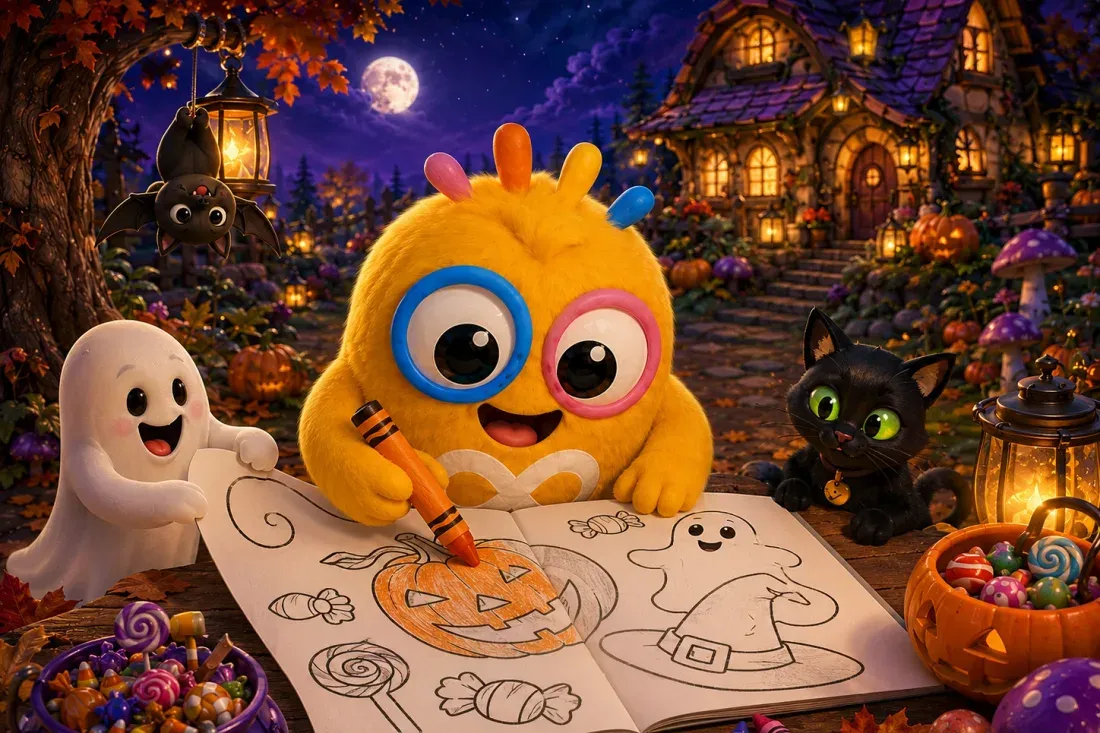
A search-and-find game builds visual attention, vocabulary, and patience — three things you never think to practice on purpose. And a child who’s searching is a quiet child, which has never hurt anyone.
To make it more interesting than a plain list of objects to spot:
- Set a three-minute timer instead of unlimited time. The stakes change everything.
- Search by category: “find everything that flies,” “find everything that’s orange.”
- Switch roles. Your child gives the clues and you search. They discover how hard it is to describe something well.
Eight Halloween Activities for Ages 3 to 8
None of these need special supplies. Most take under thirty minutes.
- The house pumpkin hunt. Hide five small paper pumpkins around the living room and give one clue at a time. It fills twenty minutes and costs nothing.
- Coloring in twos. Two crayons, one page, one side each. Your child negotiates colors with you instead of coloring alone in a corner.
- The invented monster. Your child draws a monster, then gives it a name, a favorite food, and a fear. Coloring becomes storytelling.
- Yarn spiderwebs. A cardboard frame, white yarn, and your child weaves. Fine motor skills disguised as a craft.
- The blind taste test. Peeled grape, cold spaghetti, a piece of pumpkin: touch with eyes closed and guess. The classic that still works.
- The paper costume. Before buying anything, have them draw their dream costume. You’ll finally know what they actually want to be this year.
- Pumpkin seed roasting. After scooping out the pumpkin, roast the seeds with a little salt. Your child was there from start to finish, and nothing went to waste.
- Flashlight story time. Lights off, a story, a flashlight. October 31st’s evening needs a gentle landing.
At School and in Daycare
If you teach preschool or work in early childhood education, these activities work well as independent stations while you’re with another group.
For a kindergarten group, print a pumpkin at 11 × 17 and have several kids color it together — it becomes a classroom door poster. For early elementary, a black cat page pairs well with a writing exercise: color, then write three sentences about what that cat is doing tonight.
And for settings that replace candy because of food allergies, a coloring page tucked in an envelope is still a treat that delights without the risk.
After October 31st
Look & Loop designs coloring books and search-and-find books made for kids here, with scenes they recognize. Our books continue what a few printed pages started — across dozens of pages instead of a single evening.
Frequently asked questions
At what age can kids start doing Halloween coloring pages?
As early as age 3, as long as the shapes are big and the lines are thick. Search-and-find games work well starting around age 4.
What paper should I use to print coloring pages?
Regular 90g paper works fine for crayons. With markers or paint, switch to 160g so the ink doesn't bleed through and the page doesn't warp.
How do I keep kids busy on Halloween without giving out candy?
Swap the sugary reward for an activity reward: a coloring page, a search-and-find card, a sticker. Many schools and daycares already work this way.
What should we do with the coloring pages once they're done?
The simplest thing: display them. A string and a few wooden clothespins turn finished pages into decorations, and your child sees their work matter.